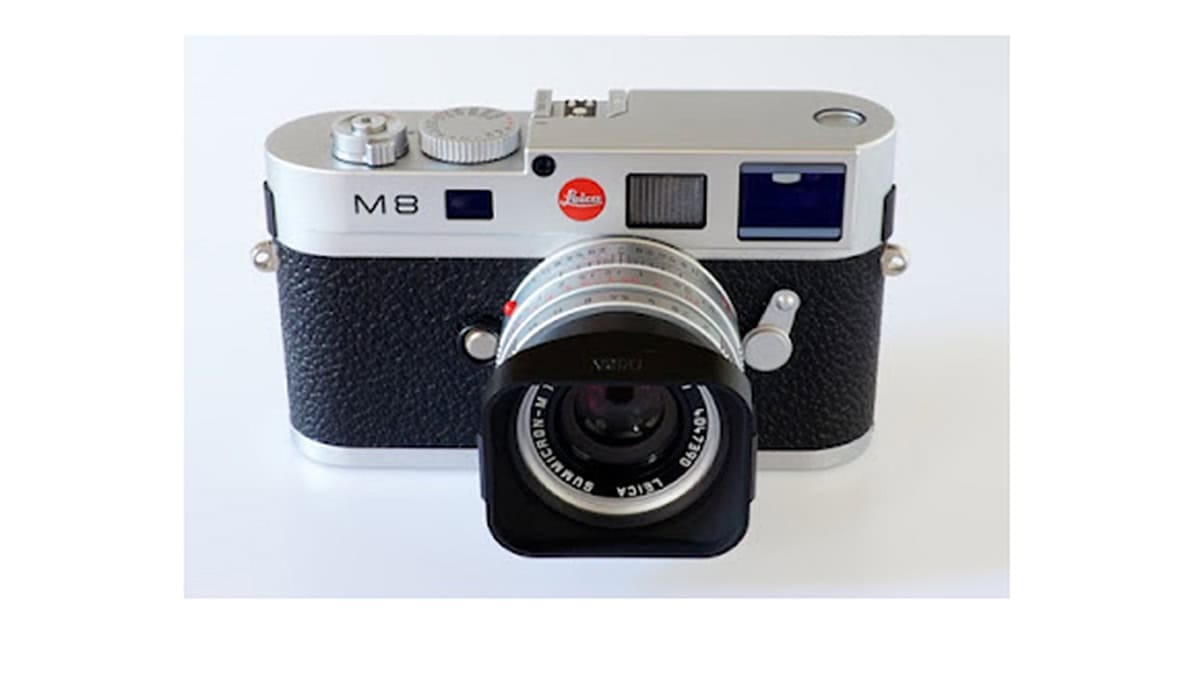
The Leica M8.2 is a reworked version of the original M8 launched in late 2006. At the time, the Leica M8 received mixed reviews, and the M8.2 was Leica’s response to some of that criticism. At $5,995 / £3850 body-only, the Leica M8.2 is around $ 2,000 / £ 1,000 more than the original M8, which is still made. The differences between the two, then, are meant to placate those who thought the M8 fell a little short of expectations. If you’re not familiar with the company, Leica is a small but highly influential camera maker that appeals to a wide range of photographers, from working professionals to enthusiasts, as well as the most serious collectors.
However, Leica must serve diverse customer needs to survive. Historically, many imaging professionals unfairly criticised the manual, mechanical Leica M6 for its built-in meter. As digital SLRs emerged, the Leica M7 was dismissed by some as a “serious” camera because of its electronic shutter. Leica addressed this by introducing the mechanical MP, with a built-in exposure meter, that appealed to both groups. So with that, it was perhaps only natural that there were concerns from some quarters when the company announced the digital M8.
Like most new offerings from the company, the Leica M8 was criticised by professionals at first, but after time was largely accepted. One of the main gripes, apart from the 1.3x FOV cropped sensor, was the sensitivity to infra-red, but a noisy shutter, inaccurate frame lines at mid-distance and plain-looking body covering was just too much for some users and reviewers.

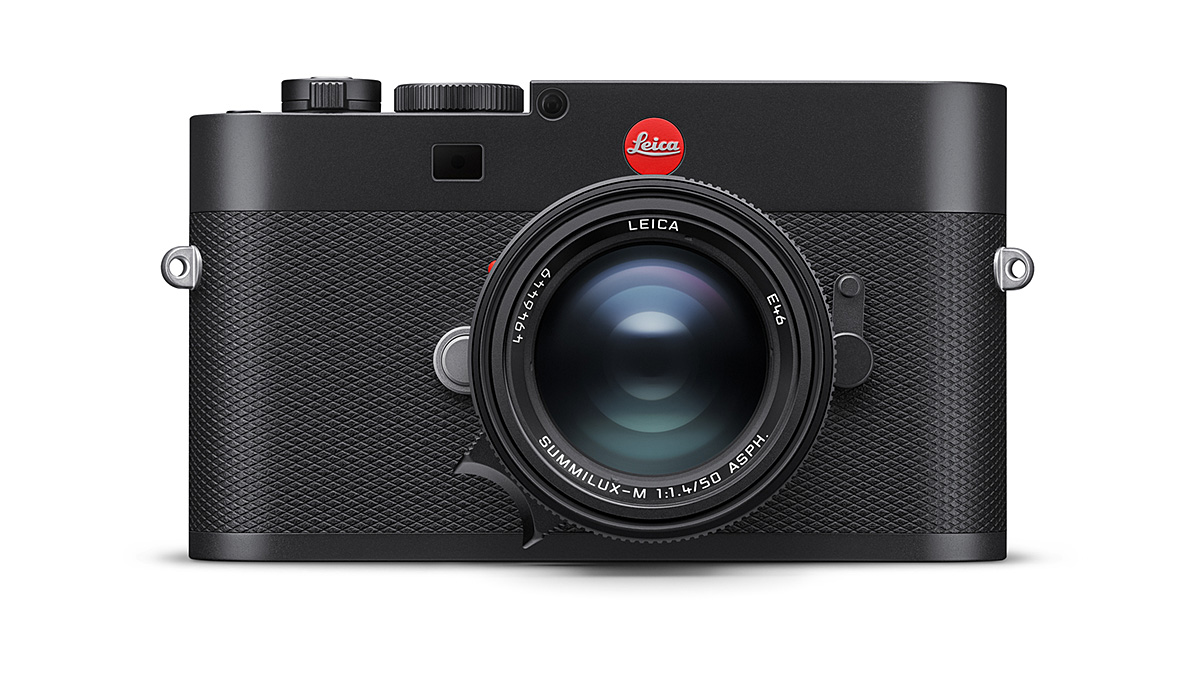
The M8.2 has the same body, layout and controls, though the matte black-chrome finish version has been replaced by a classy black-paint model; it will “brass,” but it’s generally accepted as being more desirable. The cosmetic changes have been a success, but replacing the body material with a hard-wearing, traditional-looking, slightly slippery synthetic vulcanite covering hasn’t worked quite as well, though it’s not a major concern.


This is, of course, a rangefinder camera; you don’t view through the taking lens, rather focusing and framing are achieved through a separate finder. Most of the common focal lengths use the built-in finder that sets frame lines automatically, though longer focal lengths, 90 mm for instance, occupy a small frame in the centre of the viewfinder. It can be a shock if you’re a DSLR user. Ultrawide lenses need an add-on finder, much like that seen reintroduced with the Olympus E-P1, but that additional real estate, surrounding the area captured by the sensor, can be an aid to composition.
Focus is all manual; the brass helicoid adds to the overall weight of the lenses, but durability and optical precision are of paramount importance. You’ll have to reassess your focusing skills, but it’s a relief from inaccurate distance detection and the occasional hunting back and forth of autofocus systems. Sure, we got some out-of-focus shots, but it was down to us, not the CPU.

Around the back, the LCD screen stays the same 2.5 inches in size and resolution, which, for the most part, is perfectly adequate for day-to-day use, including focus confirmation. The only change being the protective cover is now made from scratch-resistant sapphire glass. Menu operation isn’t quite as slick as it could be. Every setting, either from the shortcut menu or the main menu, requires confirmation before being accepted, which is fine once you get used to it. Settings don’t get changed accidentally, and a well-placed Set button means it’s not as big a chore as it could have been. A rear command wheel is welcome for selection and focus confirmation, but I found it a bit stiff in operation, though it feels like it will last a lifetime’s use.

Leica has also altered the shutter mechanism (it’s the same full-frame shutter from the R9 SLR), and while not as quiet as some high-end digital compacts, the noise is not unbearable and can be quietened further for single-shot use by delaying the noisier charging cycle till releasing the shutter button. Burst shooting isn’t exactly a strong point, but then it’s probably ample for most needs. I managed to capture ten Raw+ JPEG ‘fine’ files in 5.6 seconds (1.8fps), before the buffer filled and the camera stalled.
I’m not quite as impressed by swapping the 1/8000sec max of the M8 for a snapshot mode using auto selection of shutter speeds, ISOs, and JPEG capture only, along with a couple of suggested apertures, based on the lens in use. It won’t appeal to the majority of users, but it’s easy enough to ignore if you want to. For all that, the M8.2 offers manual exposure and aperture priority, just like the 35mm analogue M7. Indeed, the M8 and M8.2 are amongst the least complicated digital cameras available; I found it made me concentrate more on our subject than endlessly checking and re-checking our settings. To that way of thinking, that’s got to be a good thing.

In terms of performance, the M8.2 likely won’t impress pixel peepers; noise levels are higher than you might expect, with the maximum ISO 2500 being very digital-looking. However, noise is detectable in shadow areas at ISO 320, but is fine-grained up to ISO 1250 and not unlike film in look. That’s not as big a deal as it might sound for low-light shooting. Thanks to the lack of a reflex mirror with its inherent image softening effect, rangefinders can use shutter speeds of at least one or two stops slower than SLRs.

Best of all, though, using the defaults, Leica has set metering and exposure to deliver JPEGs with a good balance overall by means of excellent exposure and tonality, as opposed to the overexposed look for consumers or the pro-preference for slightly underexposed images. Shadow and highlight detail is excellent without either being excessively clipped, except in the most tricky (strongly backlit) lighting. Out of camera mono (JPEG) images are sublime, if you like slightly lower contrast shots, that is, which I do.


White balance is generally good, though the propensity to reveal ruddy skin tones and for magenta casts from certain black coloured synthetic materials under tungsten lighting doesn’t differ that much from the M8. The thin (0.5mm) sensor coverglass means detail from M-mount lenses is very high with Raw files, but I was unable to test it definitively using my preferred test target.
Leica aren’t competing with a specific rival camera; the Epson R-D1x isn’t freely available in the West, though several models may be tempting, especially if price is a concern (when isn’t it?). The most immediately obvious, perhaps, is the rangefinder-like (mirrorless) Olympus E-P1, especially as the short flange back distance means M-mount lenses can be fitted with an adaptor. Even without the ability to use M-mount lenses, the E-P1 works pretty well as a small, discrete camera for candids.


Search for the Leica M8.2 secondhand at MPB or KEH [affiliate links]