Lens Reviews

From the past: Samyang/Rokinon T-S 24mm F3.5 review

An edited version of my review first appeared in the British Journal of Photography* magazine well over a decade ago.

With their range of movements, tilt and shift lenses offered in various focal lengths for 35mm full-frame DSLRs have become indispensable for architecture, interiors, still-life, food and product photography. Before Canon redesigned their film-era 24mm version with an improved optical design and, uniquely, adding a user-selectable option of aligning the tilt function with the shift movement, these lenses were quite reasonably priced.

A little over four years ago, Canon offered three focal lengths (24, 45 and 90mm). At just £899 inc VAT, the low price suggested that these were marketed as a “loss leader,” intended to entice users to switch. At that time, with just one Nikkor PC 85mm F2.8D model in the range and with it lacking automatic aperture control, main rival Nikon was lagging, in this sector anyway.

Nevertheless, Nikon was soon to refresh the 85mm, while also adding a 24mm and 45mm model, each with electronic automatic aperture control (a first for Nikon), identified by the PC-E designation. As with the earlier Canon TS-E models, the lack of the option to tilt and shift in the same plane prompted some users to call these lenses “shift and swing.” While you can specify the movements to be aligned at the factory when ordering, or retrospectively via the subsidiary for a fee, it’s not exactly flexible if the user wants to switch back and forth regularly.

While Canon has yet to upgrade the 45 and 90 mm models to include this sought-after feature (at the time of writing), the upgraded version, the TS-E 24mm F3.5L, retails at just over £1,700, while the less versatile Nikon PC-E 24mm F3.5 D ED  is just shy of £1500.

Third-party offerings are somewhat limited. There are high-end German-made Schneider Kreuznach models that start at £2,800 for the 90mm but increase dramatically to £5,400 for the 28mm. Crucially, though, these can tilt while shifting, like the new Canon models.

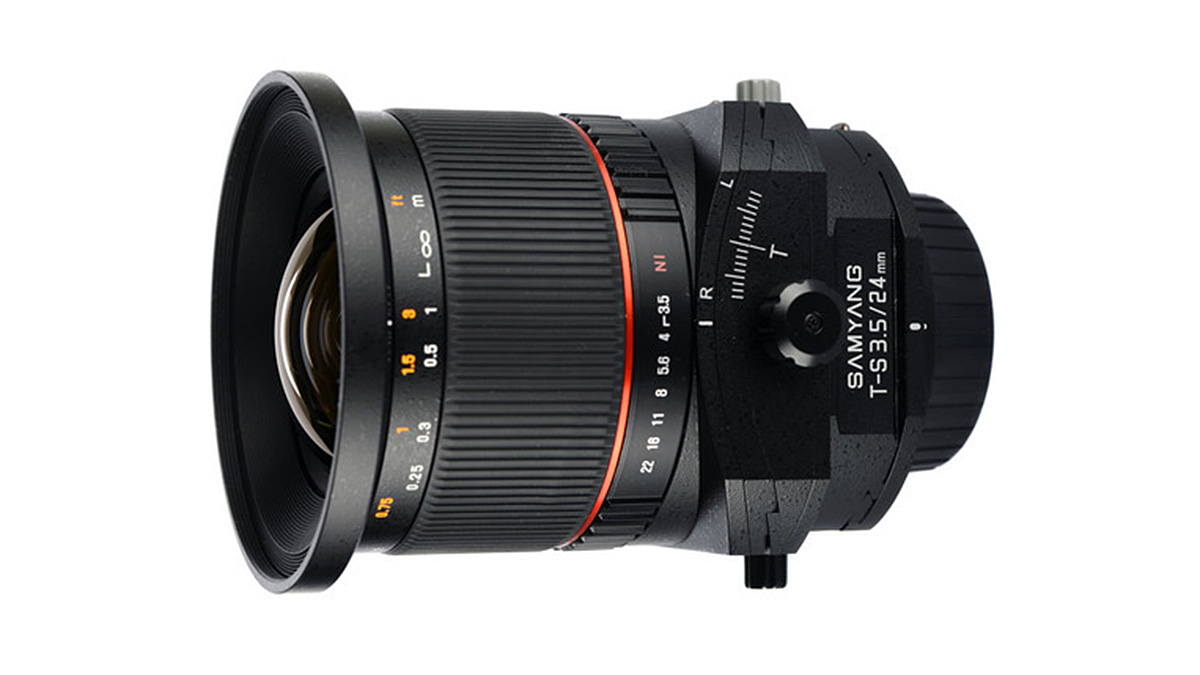
Sigma and Tamron are completely absent in this space. However, ROK-based newcomer Samyang (Rokinon in the US) has become the first to offer an accessibly priced T-S model, a 24mm F3.5 at £950 inc VAT. What’s more, the lens is available in several mounts, including Sony A and Pentax K, as well as the usual Nikon and Canon. The manual claims Sony E, Samsung NEX, MFT and even Fujifilm X-mount are available, but these have yet to be seen.

The optical construction is promising with 16 elements in 11 groups, of which two elements use ED glass and two adopt aspherical surfaces. Movements are similar to rivals with ±8.5-degrees of tilt, and ±12mm of shift.

As with other lenses in the Korean maker’s range, the Samyang T-S lens lacks autofocus, obviously, but neither is there any automatic aperture control. In fact, there are no mechanical or electronic interfaces on the lens mount, so there’s no lens data exchanged (or EXIF data visible in post). The Schneider models are the same in that respect. Most cameras don’t have a problem with stopped-down metering, but in use, it’s simply all too easy to forget, especially if you have already worked with the Canon and newer Nikon equivalents with their electronic aperture control.

Build quality is good rather than great. The body, including the tilt-unit and shift plate, is made from an aluminium alloy, but the plastic aperture collar seems rather cheap. On a short-term loan, it’s impossible to say just how well it would stand up to professional use. A quick look inside the lens’s throat shows the rack and pinion teeth appear robust, but the same can be said of the Canon models, which are known to break—usually when trying to adjust them while the mechanism is locked.

The lens is supplied without a hood, which is an oversight as the front element is both barely recessed and heavily convex. To its credit, it’s largely free of flare on a Canon EOS 1 DS MK III I used for testing, but it is highly prone to ghosting. Patches are small, but it’s worth shielding the lens at all times if shooting even vaguely towards the sun.

a panorama showing a small tree in the centre an cloudy sky
While one of the less visually interesting stitched panoramas taken with the Samyang, this particular image was chosen for the presence of ghosting (seen to the left of the centre tree and upper centre right). It’s a fairly common phenomenon with this lens, necessitating effective shielding and one of the few reasons that dictate the likely use of a tripod.

A small depth of field scale is included, though this is largely redundant on today’s high-res digital bodies. With the relatively short throw of the manual focus collar, especially between infinity and 1 meter, focus accuracy is crucial. My Canon focus screen is usually accurate enough for manual focusing at this maximum aperture, but I had several poorly focused images when handheld. And, that’s despite owning two Canon TS-E lenses (one a 24mm) and having experience reviewing virtually every other model for DSLRs, including the Hasselblad HTS adaptor. I can only conclude that tethering or focusing by live view (or EVF if you have it), where the image can be magnified, is essential.

As with the Nikon and Canon models, the Samyang adopts knurled controls to adjust the movements and has smaller versions of the same positioned 180 degrees apart on the outer casing to lock them. These are all made of plastic and are quite small. They’re also fiddly to use when the movements and their associated controls are 90 degrees apart, let alone when the tilt option is aligned with the shift movement. The much more expensive (and much larger) Schneider models avoid this scenario completely by adopting locking collars and by duplicating markings on the barrel, which may account in some part for the additional price.

Although the slim profile of the Samyang’s controls is a necessity to avoid obstructing each other, it is not the Samyang’s only shortcoming. More of an issue is that movements are slack, and that once unlocked, the barrel is free to move and more often than not simply drop, due to gravity. This alone makes it almost impossible to use without error when hand-held, something that I do regularly with my own TS-E lenses. Locked down on a tripod, it’s a different story, but it’s an unnecessary complication that’s avoided with the Canon and Schneider models. That said, the Samyang is sharp centrally wide-open, but optimal performance isn’t achieved until stopped down to F5.6-8. Some slight fringing is visible on high contrast edges if you look carefully, but it’s negligible and easily removed in post.

For me, the Samyang T-S lens’s inability to reliably hold tilt and shift movements while making adjustments for occasional hand-held use is disappointing. However, if it’s to be used exclusively on a tripod, as is often the case, the Samyang can be recommended. It will certainly be attractive to Sony full-frame users, where the EVF and focus peaking of the Sony SLT-A99 will be a huge advantage over the optical viewfinders in the current Nikon and Canon models.

US Links

B&H in New York at $999.

Adorama at $999.

Amazon at $859 (Branded as Rokinon)

UK Links

WEX at £949

Amazon UK at £813


*No intentional relation to the title of this site. In fact, I had originally intended to call this site the ‘Digital Journal.’