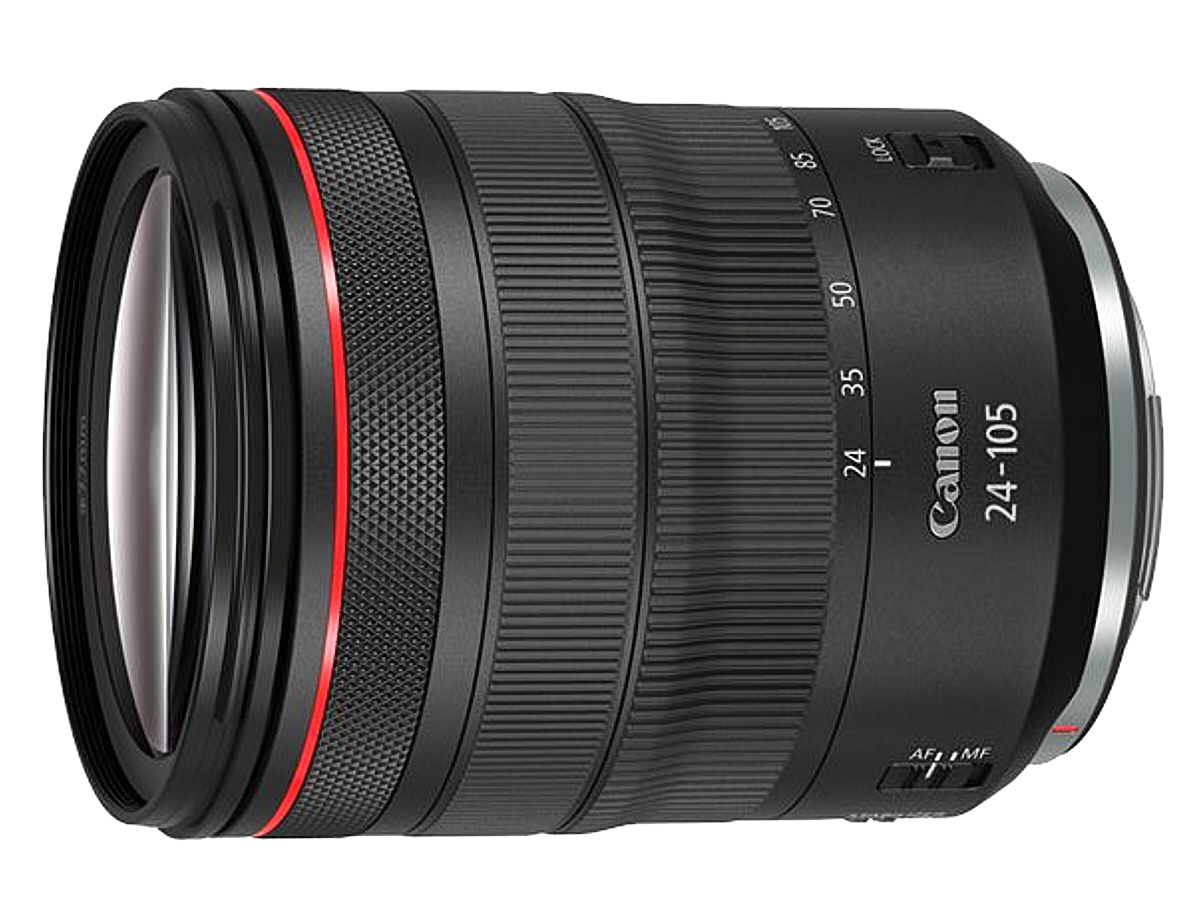
Canon 24-105mm zoom lens on a white background
Lens Reviews

Canon RF 24-105mm F4L IS USM lens review

What is it?

Bearing the prestigious L-series designation, the Canon RF 24-105mm F4L IS USM is a versatile 4x zoom with a decent wide and telephoto coverage and a 0.45m minimum focus distance. It’s also the first in the RF mount to feature a new, compact “thin” Nano USM actuator providing quiet yet fast AF. According to Canon, it is also “particularly well-suited to stop-and-start operation that’s quite common in video shooting. It also helps ensure much smoother AF during video acquisition.”

As such, it’s the kind of zoom lens that appeals to photographers and those who also need some video capabilities, for example, when recording interviews. This would be a typical scenario, but the range is useful for most other footage.

Announced alongside the impressively high-speed RF 28-70mm F2L USM, this lens is notably smaller and lighter, making it a decent match for the compact design of the mirrorless EOS R series cameras. With a new cosmetic look when compared to the EF model, the construction is quite similar, with a primarily polycarbonate outer shell and barrel.

Focusing is electronic and reversible; it’s useful if you’ve come from a rival brand or are integrating with others in a cine setup. AF operation is not quite as fast as the 24-70mm F2.8 models (EF and RF), but it is smooth and precise, even in low-light situations. 

Like rivals, there’s no distance scale on the focusing ring, but RF lenses now include a customisable knurled control ring. On this lens, it’s conveniently positioned in front of the manual focus ring. Customisable options available via the camera include ISO selection, exposure compensation,  Av and Tv options, white balance and more (depending on the camera model). While the control ring cannot be de-clicked – there’s a light audible clicking in use – it is still a very welcome feature.

The zoom action is smooth and well-damped, which is good, as the locking feature – a slider on the barrel – is really for storage, and to prevent the lens from extending. Image stabilisation is another highlight, but its effectiveness can be improved with a body that has built-in stabilisation.

How does it perform optically?

With 18 elements arranged in 14 groups, this lens adopts an advanced construction. A UD element is used to mitigate both lateral and longitudinal CA, which it does reasonably well. Images show some colour fringing at times, but it’s well-controlled and now easier to clean up in Capture One and Lightroom than it was. It also has three aspherical elements that keep distortion, astigmatism and spherical aberration pretty much in check, though the barrel-type distortion seen at the wider end and pincushion at the other is quite typical and also easily adjusted without much compromise.

Profiles aren’t enforced in Lightroom or Capture One when using RAW files, so you can switch the distortion and vignetting correction off if images look too stretched and unrealistic or when you want to make the adjustments yourself. Disabling Chromatic Aberration correction makes little sense, but even then, this lens doesn’t exhibit that much anyway.

In many respects, it mirrors the EF version in terms of sharpness, but with slightly improved and more consistent performance across the frame. The wide-end is best in terms of resolution and contrast, but it’s also strong in the 50-70mm range.  With a drop in contrast and resolution slightly at the edges of the frame, the lens is weakest at 105mm, but it’s still a commendable performer.

Zooms rarely have any redeeming optical “character.” Lens blur is usually not worth noting, at least in an attractive or positive manner, and the way they render or ‘draw’ is usually compromised by their convenience. I feel fortunate in that I have an EF 24-70mm F2.8L USM, which I’ve kept for its attractive drawing style, likely the result of some astigmatism. But there’s something about the way this one draws that’s difficult to describe. It’s attractive certainly, and sharp as well, but there’s something else that gives this lens some extra dynamic. Whatever it is, it’s nice to see.

The lens comes with a plastic bayonet-type hood, but this one doesn’t use friction over a notch to hold it in place, which always feels like you’re twisting and damaging the barrel. Instead, this lightweight hood attaches smoothly and locks using a button – other makers, please take note. Not that I use it that much anyway, as hoods always make the lenses feel significantly bulkier. What I would like to see are smaller and shallower, locking-type hoods offered as an option. German brands B+W and Heliopan used to offer screw-in metal hoods, but how difficult could it be to design lighter-weight plastic types? Anyway, flare and ghosting are mostly well controlled, thanks to the addition of Canon’s proprietary Air Sphere Coating (ASC) in conjunction with the usual SSC coatings. Still, it has an exposed, large front and element, so some care must be taken. 

Front and rear elements also have a fluorine coating, which reduces the likelihood of stubborn dust and greasy fingerprints adhering to the surface, and even prevents stubborn water drying marks from exposure to the odd drop of rain, which can be very difficult to remove. Fluorine coatings like this make cleaning much easier. 

Conclusion

Zooms, for the most part, aren’t known for their interesting or attractive optical characteristics.  Typically, the quality of out-of-focus blur is usually not worth noting for its attractive qualities and the way they render is almost always compromised by its convenience. But there’s something about the way this one draws that’s unusual even at this level; it’s an L series after all. The Canon RF 24-105mm F4 L IS USM is sharp, not all the way through the zoom range admittedly, and the contrast drops off towards the long end, but in the 50-70mm range, it’s highly impressive. It’s also fast, smooth and relatively quiet when focusing, while being small enough to carry around all day. In fact, I’ve rarely used the 24-70mm F2.8L since buying the lens. Indeed, it’s this all-round performance that makes it easy to see why this lens is so appealing for photographers working in many different genres, including those that include video, and therefore the Canon RF 24-105mm F4 L IS USM is easy to recommend.


Technical Data

ManufacturerCanon
ModelRF 24-105mm F4L IS USM
Webwww.canon.co.uk
Elements/construction18 elements in 14 groups (1x UD, 3x Asph)
Angle of view84-23.2 degrees (diagonal)
Max apertureF4
Min apertureF32
Min focus distance0.45m (1.48 ft)
MountRF mount
Filter size77mm 
Length107.3mm (4.22 in)
Diameter83.5mm (3.29 in)
Weight700g (1.54 lbs)
Price£1440 inc VAT ($1,499)

Sample Gallery

Isle of Dogs, financial district
Old v. New. Isle of Dogs and Greenwich, London . Canon EOS R with Canon RF 24-105mm F4L IS USM, 105mm at F8, 1/200sec at ISO 100. Breakthrough Photography X2 UV filter. Processed to taste in Lightroom Classic, profiles on.


Cutty Sark, Greenwich, London. Canon EOS R with Canon RF 24-105mm F4L IS USM, 24mm at F5.6, 1/500sec at ISO 100. Breakthrough Photography X2 UV filter. Processed to taste in Lightroom Classic; profiles for vignetting and distortion turned off. Some slight vignetting shown.


Greenwich, London. Canon EOS R with Canon RF 24-105mm F4L IS USM, 24mm at F5.6, 1/500sec at ISO 100. Breakthrough Photography X2 UV filter. Processed to taste in Lightroom Classic, profiles on.


Check stock and prices of the Canon RF 24-105mm F4L IS USM at the following retailers [Affiliates]:


Articles may include affiliate links. If you purchase through these links, we may earn an affiliate commission at no extra cost to you.