Leica recently launched a new version of its classic Summilux-M 50 F1.4 lens from 1959. Kevin Carter takes a look.
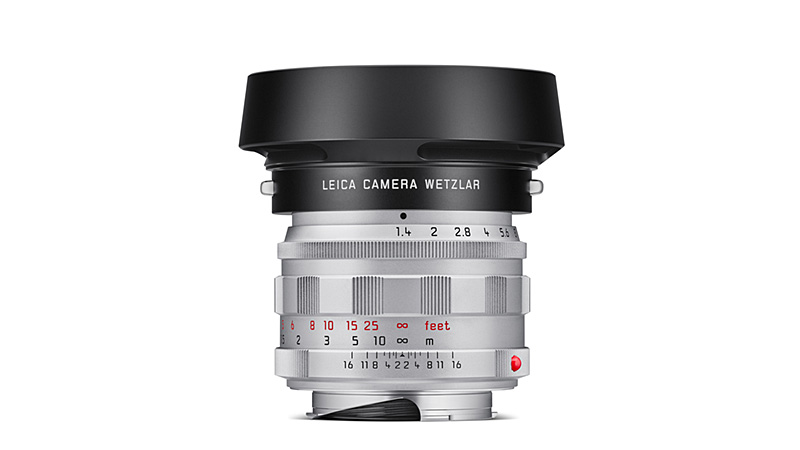
As the fifth in the Classic Line series, following the Summaron-M 28 F5.6, Thambar-M 90 F2.2, Noctilux-M 50 F1.2 ASPH, and the Summilux-M 35 F1.4, the newly reissued M-mount model features vintage Leica styling, including a scalloped focusing ring and chrome-plated brass construction. To complete the vintage aesthetic, there’s even a circular, “vented” hood in black with chrome locking buttons.
Optically, the lens is based on the second Summilux-M 50 f/1.4 (II) formula, a design that promises highly attractive rendering, wide open, with soft blur transitions to out-of-focus highlights. The new lens is also said to deliver higher sharpness and higher contrast images when stopped down than its predecessor. While this second version ran almost unchanged from 1962 to 2004, the new remastered lens features special glass types and modern lens-making practices. It also has an extended close focusing distance of 0.7m when used with the Leica M’s optionally available EVF or the camera’s rear LCD.
I reviewed the lens courtesy of Leica UK on the new Leica M EV1. That camera swaps the traditional optical rangefinder for a built-in electronic viewfinder, taking full advantage of the closer focusing distance. And of course, like LiveView on the Leica rangefinders, all focusing is at the taking aperture, so aperture-dependent focus shift will be avoided.
The recently reissued lens features seven elements in five groups, has 12 aperture blades, weighs a hefty and solid-feeling 417g, and adopts the popular (for Leica M) E46 (46mm) filters. It feels quite heavy in the hand and reassuringly robust. However, once on the camera, that heaviness subsides. On the Leica M EV1, which is lighter than a typical digital M, the balance was excellent, without it feeling too front-heavy.
Manually focusing the lens was also a highlight, but it’s something you can easily take for granted when you’re already familiar with Leica M lenses. The finely machined, all-metal ‘scalloped’ focusing ring is a throwback to earlier days, obviously, but besides the wonderfully tactile experience, I find this design helps with fine focusing. As you might expect at this level, the weighting is excellent, and the action is smooth, not unlike moving a spoon through syrup. And while the angle of focus rotation is on the short side (for rapid focusing), particularly between 25ft/10m and infinity, the magnification option available with the EVF of the Leica M EV1 made focusing a breeze. Not only is the metal aperture collar nicely serrated with click-stops at full and half increments, but this lens also features similar serrations close to the mount, making the mounting and removal of the lens more positive and secure.
How does it perform?
The initial aperture has good central sharpness and a little of the typical glow from slight spherical aberration. While not quite up to the modern Summilux 50mm 1:1.4 ASPH, in sharpness and contrast wide open, it has an attractive, delicate drawing style which would particularly suit portraiture. Stopping down, the slight aberration quickly disappears, revealing very high sharpness and contrast to F16.
Some slight lateral chromatic aberration is visible on high contrast scenes, and there’s a little vignetting wide open, obviously, but nothing untoward. The modern coatings help with mitigating flare and ghosting. However, in a torture test, photographing towards the sun with it just outside the frame, some slight veiling flare and a little ghosting can be seen at times. A ‘vented’ hood is available, though I didn’t have one available during the test period. In truth, I find most hoods a nuisance, but a short hood can be useful. Some slight barrel distortion can be detected on straight edges that are parallel to the image frame, but it’s not noticeable in everyday scenes and nothing that can’t be sorted out in post if needed.
Conclusion
Admittedly, the lens is something of a considered choice. Still, I can see there’s a lot to like about it. For me, the vintage optical character in a new lens is the main draw. Buying an old lens secondhand for a vintage look (image aesthetic, not construction) is an option, but that’s not usually straightforward unless it’s purchased through a reputable dealer. Of course, visually, it would pair well with any chrome Leica M body, if that’s important. However, in retrospect, I think I should have reviewed it on a Leica SL3/3S and tried some filming. Either way, though, sitting alongside the ASPH version in the range (which is arguably the best, most rounded-performing 50mm lens money can buy), the less technically-perfect Leica Summilux-M 50 F1.4 is a rather nice option to have. Indeed, I may even prefer it. Better still, at around £3,310.00 / €3,850.00 / $3,895.00 incl. VAT makes it even more affordable.
Check price and availability at the following stores:
Park Cameras (UK) |Leica UK (Leica Online Store)
B&H Photo (US) | Adorama (US) | Leica US (Leica Online Store)
The lens is now also available in a glossy black finish.
Technical data:
| Lens | Leica Summilux 50 mm F1.4 Classic (11 714) |
| Angle of view (diagonal, horizontal, vertical) | 45°, 38°, 26° |
| Optical design | |
| Number of elements/groups | 7/5 |
| Number of aspherical elements | n/a |
| Position of entrance pupil in front of the bayonet flange | 29.8 mm |
| Focusing | |
| Working range | 0.7 m to infinity |
| Smallest object field | 275 x 413 mm |
| Largest reproduction ratio | 1:12.5 |
| Aperture | |
| Settings/functions | Click-stop diaphragm with half-increment settings |
| Aperture setting range | 1.4 – 16 |
| No. of blades | 12 |
| Bayonet/sensor format | Leica M-bayonet, full-frame 35 mm format |
| Filter thread | E46 |
| Dimensions and weight | |
| Length to bayonet flange | 45 mm (71mm with hood) |
| Largest diameter | 58 mm |
| Weight | 417 g |
Samples