Fujifilm GFX100S II review
What is it?
Released in June, 2024, the Fujifilm GFX100S II is an update to the Fujifilm GFX100S, the smaller, more compact model that sits just beneath the flagship Fujifilm GFX100 II. It features a slightly upgraded 100MP sensor with a revised microlens structure, which is said to improve image quality at the periphery and AF accuracy out towards the edges of the frame. The redesigned sensor also features a new lower ISO base of 80, which is claimed to deliver lower noise and a wider dynamic range than the GFX100S. Further refinements include AI-assisted subject detection AF and improved continuous shooting speed of up to 7.0 frames per second.
While these updates are welcome, the best news perhaps is that the in-body image stabilisation function has also been substantially upgraded. It was already effective, but it’s now a 5-axis variant that counters camera shake by up to 8 stops (up from 6 for the GFX100S), which is even marginally better than the flagship GFX100 II. Like its predecessor, there’s a multi-shot mode, which is said to provide “4x resolution” (400MP) and more accurate colour reproduction.
At just 883g body-only, Fujifilm has even shaved a few grams off its predecessor, which weighed 900g. As a comparison with rivals at a similar price point, the smaller 35mm-format 45MP Canon EOS R5 weighs 738g. So you can see the Fujifilm GFX100s II is actually pretty light for a medium format (MF) camera. Admittedly, the Canon EOS R5 targets a slightly different, more press/sports-oriented market, but there remains quite a bit of overlap. Where a decade ago, with digital MF cameras, a tripod was a necessity in the field when light levels dropped, the new Fujifilm GFX100S II sounds like it might be the perfect landscape camera.
Key features & benefits
- 100 MP MF camera with compact form-factor – ideal field camera
- Improved microlens of the sensor enhances image quality and AF accuracy at image edge
- 5-axis IBIS to counter camera shake, up to 8 stops
- 3.2-in LCD, tilt-out type with double hinge
- 5.76-million dot EVF with a high magnification ratio of 0.84x
- Pixel Shift Multi-Shot feature enables 400 MP stills
What’s it like?
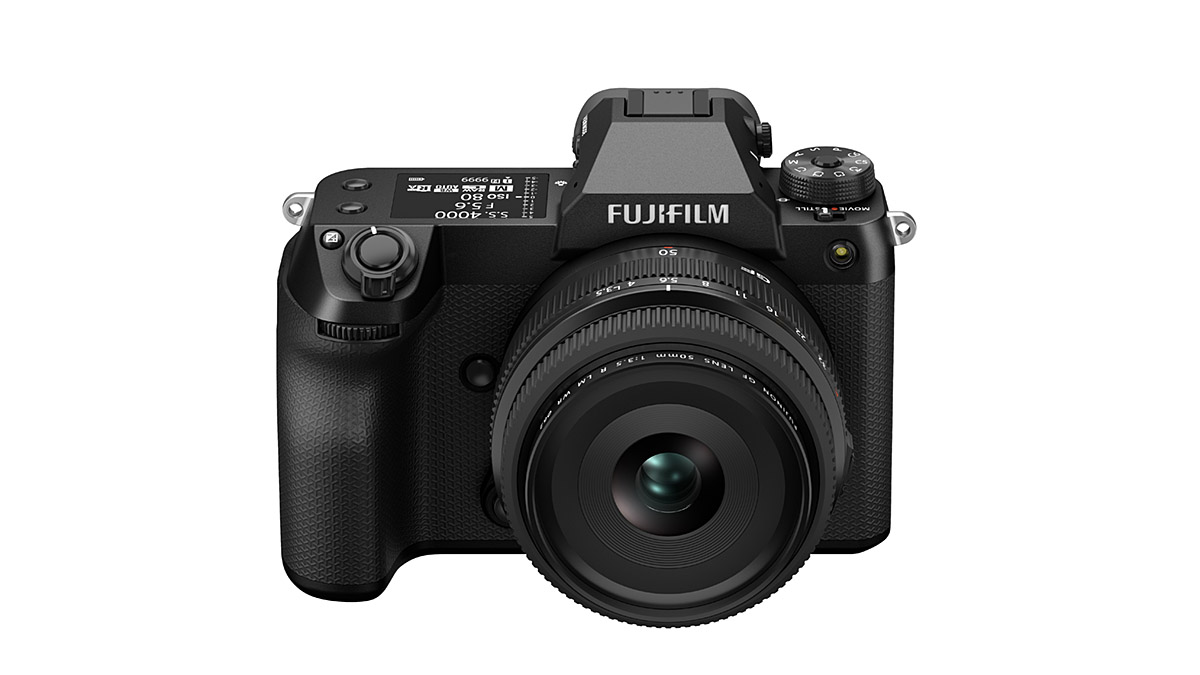
In the hands, the camera has a no-nonsense, almost workmanlike feel, and it’s not the prettiest to look at, either. Build quality, though, is very good, but it’s not quite at the same level as the flagship GFX 100 II. Still, those who view cameras as tools won’t care about looks. What’s immediately apparent is the huge lens mount, and unlike the slightly smaller semi-pro/pro 35mm mirrorless bodies such as Canon EOS R5, the GFX100S II doesn’t feel quite so solid or dense. Nevertheless, it appears fairly rugged and feels very comfortable and reassuring in the hands.
I was sent the camera with the GF50mm F3.5 (40mm equivalent) by Fujifilm UK for the review (see here), and the balance with that lens just couldn’t be any better. Larger lenses like the superb GF20-35mm F4 also balance reasonably well (based on testing on the practically identical GFX50 II), as most of the glass is arranged toward the mount.
The top plate’s LCD is a highlight; not only is it decently sized, but it’s also clearly laid out and highly legible in a range of lighting conditions. Another standout feature for me is the rear 3.2-in LCD, which is a tilt-out type. Not only does it tilt horizontally, making it particularly suited for horizontal use at waist level, either handheld or on a tripod, but it also tilts vertically, thanks to a double hinge. Tilting horizontally also plays well with L-brackets, which often get in the way of the side-articulating type, so it’s a good choice for a landscape-oriented camera.
Autofocus is reasonably brisk and accurate, but this is obviously not a sports/action-oriented camera. Still, if the subject isn’t moving too fast, the GFX 100S II can muster an impressive 7 fps, so it’s no slouch. A bump in the resolution of the EVF is always welcome, particularly when magnifying the image during manual focus. However, I don’t recall any issue with the earlier one. However, I found the improved optics within the finder helped me settle sooner on the displayed image. I’m a bit prone to distractions with less-than-optimal viewfinders, whether that’s flare or distortion or simply not seeing the corners of the frame without properly aligning my eye to the eyepiece. I also value a higher magnification, though the two can sometimes be a trade-off. In my view, it’s something worth paying extra for, and I can trace that back to my early days using film cameras.
Does it replace a medium-format DSLR, like the Hasselblad H-series cameras? In many ways, yes, it does. Certainly, in the field, it’s a much more manageable camera. Not only is it smaller and lighter, but the IBIS and AF make it much more capable. Off-centre AF operation is enhanced by the inclusion of a well-placed and responsive joystick, which was included on its predecessor. The H-series, of course, was offered with two distinctly sized sensors, you could say full-frame 645 and cropped 645, using the same design language. The GFX100S II, as with all the others in the series adopt the smaller ‘cropped’ 645 sensor, but image quality is top-drawer with a wide dynamic range at base and low noise at high ISOs, matching or even slightly improving on the best Sony 35mm-size CMOS sensors.
In the studio, flash is limited to 1/125 sec thanks to a focal plane shutter, but if you have some legacy H-series lenses, then the optional but pricey (£649) H-mount Adapter G can use the leaf shutter in the lens for faster syncing, up to 1/800 sec. However, I’ve not tested it. AF is disabled, and some say the H-mount lenses operate in stopped-down mode only. I can think of a valid reason why it would do that, but it’s a shame if true. And, according to B&H, it’s now discontinued.
Another (slight) limitation is the adoption of dual SD cards. While not a deal-breaker, as it can record directly to SSD, it would have been nice to see a CFexpress card option, if only for the greater choice of large-capacity cards. I didn’t test the video options, but that would have made the camera more appealing for spontaneous video capture.
It would also have made more sense for the Pixel Shift Multi-Shot feature, which creates 16 RAW images in quick succession. These aren’t combined in-camera but by using the (free-to-download) dedicated software ‘Pixel Shift Combiner’ to generate a 400MP image (in High Resolution + Real Colour mode). There’s a second Real Colour mode in-camera option that combines four RAW files shot, but the resultant file remains 100 MP and still must be generated using the combiner software.
The Multi-Shot option greatly appeals to me, but it’s not perfect. It can’t be used successfully when holding the camera, unlike the Leica/Panasonic option (as found on Leica SL2/SL2-s and Panasonic S1R), and you must use the combiner software. It’s not that the software has any particular shortcomings; it’s more to do with the fact that selecting the appropriate images for processing in the first place is close to impossible and clunky at best. If each session is noticeably different, then you stand a good chance of success, but the process could be really slick if Fujifilm had devised a way of highlighting each series separately. Putting them into a separate folder during capture would have been a useful option, or for the software to automatically detect and highlight the relevant series from its metadata. Admittedly, only one frame from the series needs to be picked, as it will automatically select the others, but it’s still a cumbersome and fraught process. What’s more, you can’t even select the series from Lightroom (or any other RAW developer) and open them with the combiner, which would have been really polished. I can see no way around it, except to use an image browser like Bridge or FastRawViewer to select one of the series and then memorise the file name/number while you open the combiner software to select that one image. As I said, it’s clunky. Generated DNG files are typically around 2GB each and 407MP from 16 RAF 102MP files.
Wrapping up
I really enjoyed my time with the camera, which, for me, is a good sign. For a medium-format camera, it’s not that much bigger or heavier than, say, the Canon EOS R5, and image quality is excellent. Lenses are typically a bit larger, though, especially the tilt/shifts compared to the Canon EF mount options, which I use. Still, the GF30mm F5.6 T/S, see the review here, and the GF20-35mm F4 (review here) are outstanding, and the tiny GF50mm F3.5 (see here) is one of my personal favourites. The Fujifilm GFX100S II (and the aforementioned lenses) could easily make me switch systems. That and the 50mm F3.5 would, I suspect, be my favourite combination for a large percentage of my documentary-style photography, and the others would easily replace my existing lenses for architecture, interiors and gardens. Admittedly, for the documentary-style work, I would prefer the same features in a rangefinder-style body like the now-discontinued GFX50R. But it looks unlikely to happen, and to be honest, I’m unsure how successful it would be with the GF30mm F5.6 T/S. Still, it may be great! I might just have to get both and be done with it.
The Fujifilm GFX100S II is available in the UK from authorised Fujifilm retailers, the FUJIFILM House of Photography in London or the Fujifilm online store at https://eshop.fujifilm-x.com/uk at a suggested retail price of £4,999 including VAT. This is £1,000 lower than the GFX100S when it was launched. The optional metal Hand Grip has a recommended price of £135 inc VAT.
Check price and stock at the following [affiliate links]
Technical Data
| Manufacturer | Fujifilm |
| Model | Fujifilm GF100S II |
| Web | www.fujifilm-x.com |
| Lens Mount | G mount |
| Sensor | 102 MP 645 full-frame (44 x 33 mm approx) CMOS sensor |
| ISO sensitivity | ISO 80 to 12,800, ex up to. 102,400 |
| Shutter | Mech. shutter: 60 min to 1⁄4000 s, E. shutter: 60 min to 1⁄16000 s Flash Sync: up to 1⁄125 s |
| AF/MF | Hybrid AF with subject detection, MF |
| Continuous shooting | 7 frames per second (fps) |
| Video | DCI4K/4K up to 29.97p, Full HD up to 59.94p |
| Viewfinder | 5.76 million dot, 0.84x mag |
| Display | 3.2-inch tilt, touchscreen LCD with 2.36 million dots |
| Connectivity | USB Type-C (USB3.2 Gen2x1), HDMI micro, IEEE802.11a/b/g/n/ac |
| Battery | NP-W235 Li-ion battery, 530 shots per charge (CIPA standard), approx. |
| Body | Magnesium alloy body, top and bottom plates. |
| Memory | 2x SD card slots (compatible with UHS-II). |
| Dimensions (wxdxh) | 150 x 104.2 x 87.2 mm. |
| Weight | Black: 883 grams inc battery and card |
Further product information can be found at: https://fujifilm-x.com/en-gb/products/gfx-series/