My Current Camera Kit
Recommendations based on equipment I’ve bought, tested and continued to use
My current camera kit has, naturally, evolved over more than 25 years of reviewing cameras, lenses and photographic accessories. One of the questions I’m asked more than any other is, “What equipment do you actually use?” This page answers that question.
Disclosure: Some links below are affiliate links. As an Amazon Associate, I earn from qualifying purchases. This doesn’t influence my recommendations or affect the price you pay.
I have an Amazon page here where I list some of the items. However, this page gives you an idea of why I like them and why I bought them.
Quick recommendations
| Favourite camera | Canon EOS R5 (currently) |
| Favourite lens | Zeiss 35mm PC Distagon |
| Essential accessory | Version 4.0 CFexpress Type B cards |
| Favourite tripod | Gitzo Systematic |
| Most underrated item | Markins ball heads |
Lenses in my current camera kit
Cameras are secondary to lens choice, so my advice is to select a lens or lens range first, and then choose the camera that best suits your needs. With mirrorless systems, the camera body choice is even less important, so you might pick one lens brand and a different mirrorless camera. As a suitable adapter is required for this route, this option is still a bit “left field” for most people. Still, it’s not uncommon with enthusiasts, especially video/filmmakers, and will likely become more mainstream in the future.
After reviewing lenses for more than 25 years, these are the ones that have earned a permanent place in my camera bag. They’re listed roughly in order of how important they are to my work today. The list isn’t exhaustive either, and I’ll add to it over the coming months.
At a glance
Most indispensable
Canon TS-E 24mm f/3.5L
If I could keep only one architectural lens, this would be it.
Personal favourite
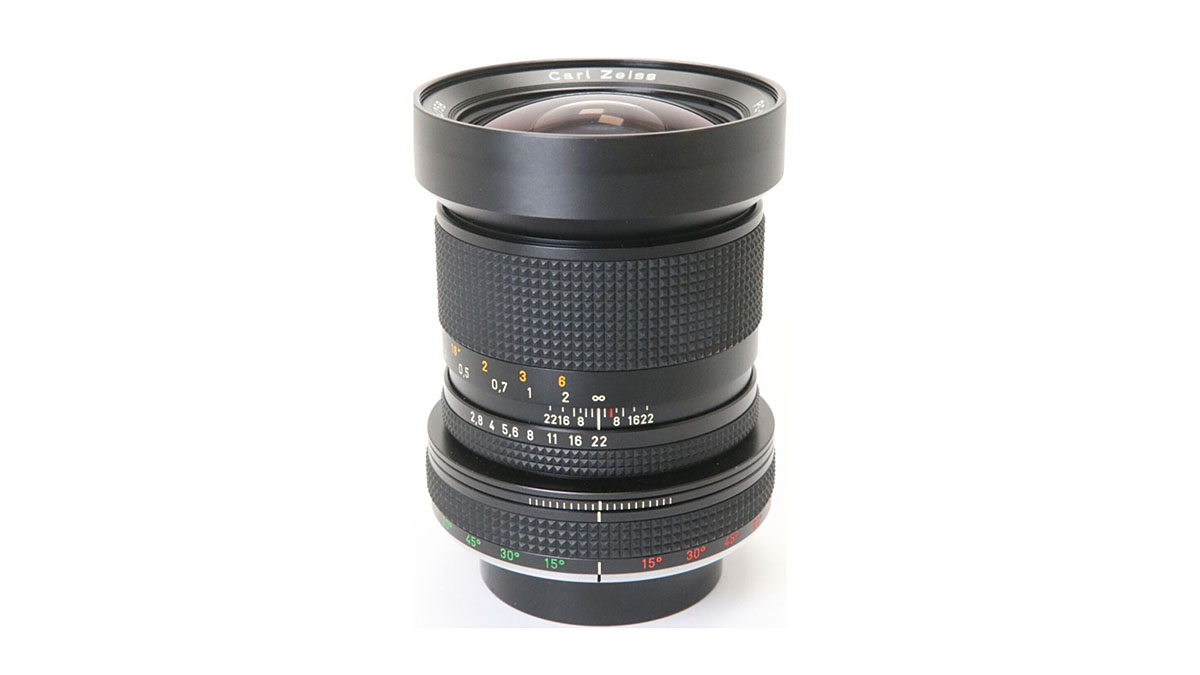
Zeiss Distagon T 35mm f/2.8 PC*
The lens I enjoy using the most because of its rendering.
Most versatile
Canon TS-E 45mm f/2.8
My choice when I want a more natural perspective while retaining perspective control.
Canon TS-E 24mm F3.5L
Why I own it
This is probably my single most important lens. Around two-thirds of my architectural and landscape work is made with the Canon TS-E 24mm F3.5L [affiliate link] perspective-control lens.
What I love
- Compact and light enough to hand-hold
- Shift movements are indispensable for architecture
- Excellent for stitched panoramas
- Uses relatively small filters
What I’d change
The original version shows its age with more chromatic aberration than the TS-E 24mm F3.5L Mark II [affiliate link]. When mine eventually wears out, I’ll replace it with the newer model, although I’ll miss the smaller size.
Would I still buy one today?
I’d likely buy the Mark II, but it’s a tough choice.
Verdict
Still one of the best all-round architectural/landscape lenses I’ve ever used and the one I’d least like to be without.
Zeiss Distagon 35mm F2.8 PC Distagon
Why I own it
If I had to choose one favourite lens, this would probably be it. The 35mm focal length sits perfectly between my 24mm and 45mm perspective-control lenses, making it incredibly versatile for architecture, landscapes and environmental subjects. More than that, it has a rendering that I find difficult to describe but impossible to ignore. Images have a depth and presence that keep drawing me back.
What I love
- Beautiful, almost three-dimensional rendering
- Ideal 35mm focal length for general-purpose photography
- Perspective control without the bulk of a full tilt-shift design
- A lens I actively look forward to using for the result
Things to know
This isn’t the easiest lens to live with. It uses stopped-down metering, which feels old-fashioned today, and filters require a separate 86mm accessory ring that’s fiddly to use, expensive and increasingly difficult to find. The lens itself is also rare, making replacement expensive should anything happen to it.
Would I still buy one today?
Without hesitation, if you can find one at a sensible price. Despite its quirks, it’s the lens I reach for whenever I have the choice, simply because I love the way it renders a scene.
Verdict
Not the most practical lens I own, but quite possibly the most enjoyable. If photographic character matters as much to you as technical perfection, this remains one of the finest perspective-control lenses ever made.
I have a (subscription-only) review of the Zeiss PC Distagon here.
Canon TS-E 45mm F2.8
Why it’s in my bag
The Canon TS-E 45mm F2.8 [affiliate link] has been one of my most useful lenses for many years. While the 24mm is my first choice for architecture, the 45mm comes into its own when I want a more natural perspective for interiors, architectural details or stitched landscapes. It’s also surprisingly capable for environmental portraits, where the combination of perspective control and focal length can produce very natural-looking results.
What I like
- Compact and lightweight, making it easy to hand-hold
- A very practical focal length that bridges wide-angle and standard perspectives
- Uses the same 72mm filters as my TS-E 24mm, simplifying my kit
- Perspective control remains invaluable for architecture and interiors
Things to know
Like the original 24mm TS-E, this is now showing its age. Lateral chromatic aberration is more noticeable than on modern designs, although it’s easily corrected in Adobe Lightroom Classic. The tilt and shift mechanisms are fixed at 90 degrees to one another, unlike Canon’s later TS-E lenses, where their orientation can be changed. For my own work, this has rarely been a limitation, but it’s something prospective buyers should be aware of.
Canon has now replaced this lens with the TS-E 50mm F2.8L Macro [affiliate link], which offers significantly improved optical performance and greater flexibility. The trade-off is size and weight; it is a considerably larger lens.
Would I still buy one today?
For photographers looking to buy new, I’d recommend the TS-E 50mm. However, if you find a well-looked-after 45mm on the used market, it remains an excellent introduction to perspective-control photography and offers outstanding value.
Verdict
It may no longer be Canon’s latest standard perspective-control lens, but it’s still a remarkably useful photographic tool. Compact, reliable and capable of producing excellent results, it continues to earn its place in my camera bag.
Memory Cards I use
Memory cards are one of those purchases that are easy to overlook, yet they’re among the most important pieces of equipment in any camera bag. A camera or lens can be replaced, but lost images often can’t. For that reason, I prefer to buy cards from manufacturers with a strong reputation for reliability rather than simply chasing the lowest price.
These days, if your camera uses CFexpress Type B, I recommend buying Version 4.0 cards wherever possible. They’re backwards compatible with current cameras, generally offer faster transfer speeds when paired with a compatible card reader, and, somewhat surprisingly, are often no more expensive than older Version 2.0 cards. While today’s cameras don’t yet take full advantage of their maximum write speeds, the higher minimum write speed performance provides a degree of future-proofing and can be beneficial for high-bit-rate video and continuous burst shooting.
Lexar Professional CFexpress 4.0 Type B Silver Series (1TB)
Why it’s in my bag
For most photographers, the Lexar Professional CFexpress 4.0 Type B Silver Series 1TB [affiliate link] is currently the sweet spot. It offers excellent performance, generous capacity and very competitive pricing, making it one of the easiest recommendations I can make.
What I like
- Excellent overall performance for stills and video
- Very fast sustained write speeds (up to 2600 MB/s claimed)
- Excellent value compared to many competing cards
- Fully backwards compatible with existing CFexpress Type B cameras
Things to know
Unlike some premium competitors, Lexar doesn’t currently offer a card refresh utility, which can help maintain long-term performance by resetting the card’s internal management tables. It also isn’t VPG 400 certified. For the vast majority of photographers, this won’t matter, but dedicated videographers may prefer a card with guaranteed minimum sustained write performance.
Would I buy it again?
Absolutely. It’s currently one of the best all-round CFexpress Type B cards available and the one I’d recommend to most photographers.
ProGrade Digital CFexpress 4.0 Type B Iridium
Why I recommend it
ProGrade Digital has earned an excellent reputation for producing reliable, professional-grade memory cards. While I haven’t tested it with every current camera, I’ve been consistently impressed with both the quality of the cards and the company’s attention to long-term reliability.
What I like
- Excellent build quality
- Available with ProGrade’s useful card refresh feature (when used with a compatible reader)
- VPG 400 certification provides guaranteed minimum sustained write speeds for demanding video workflows
- A trusted brand among professional photographers and filmmakers
Things to know
The ProGrade Digital CFexpress 4.0 Type B Card Iridium 400GB version [affiliate link] offers lower sustained write speeds than the larger capacity models, making it less suitable for the most demanding video recording modes on cameras such as the Nikon Z8, Nikon Z9 and Canon EOS R5. If you regularly shoot high-resolution RAW video, I’d recommend stepping up to the ProGrade Digital CFexpress 4.0 Type B Card Iridium 800 GB version [affiliate link] instead.
Would I buy one?
Yes. If long-term reliability is your priority, ProGrade Digital remains one of the brands I trust most, and the 800GB Iridium would be my preferred choice for demanding professional use.
A final thought: I always carry more than one memory card. Spreading a day’s work across multiple cards reduces the risk of losing everything should a card fail.
Tripods I trust
I’ll admit it, I don’t particularly enjoy carrying tripods. Unfortunately, for architecture, interiors and much of my landscape work, they’re an essential part of the job. Over the years I’ve also accepted that there’s no such thing as the perfect tripod. Different jobs demand different solutions, so I now use several depending on where and how I’m working.
Gitzo Systematic Tripods
Why they’re in my kit
If I had to recommend one tripod system for serious photographers, it would be Gitzo’s Systematic range. They’re beautifully engineered, exceptionally rigid and, importantly, supported worldwide should you ever need spare parts or repairs.
What I like
- Outstanding stability for architecture and landscape photography
- Excellent build quality
- Wide range of accessories and interchangeable platforms
- International support and spare parts availability
My setup
I currently use a Gitzo 5-series Systematic (Long) for the heaviest equipment and demanding conditions. It’s large and heavy, but it’ll comfortably support virtually any camera and lens combination.
For everyday photography, I rely on a Gitzo 2-series, which has been my preferred lightweight tripod for years. Sadly, Gitzo has discontinued this model. If I were buying today, I’d choose the 3-series Systematic, which offers an excellent balance between portability and stability.
Things to know
Carbon-fibre tripods don’t appreciate mud anywhere near as much as photographers do. Before collapsing the legs, I always wipe away mud and grit, particularly around the twist locks, to avoid unnecessary wear. If I’m expecting particularly wet or muddy conditions, I’ll often choose a different tripod altogether.
Uni-Loc 1600 Major
Why it’s still in my kit
When conditions become truly unpleasant—building sites, deep mud or anywhere grit and water are unavoidable, I leave the carbon fibre at home.
My old Uni-Loc 1600 Major (link to PDF) is heavy, agricultural and anything but elegant, but it’s almost indestructible. The reversed leg design and spiked feet make it ideal for harsh outdoor conditions where lighter, multi-jointed tripods would quickly suffer.
Verdict
It’s not a tripod I’d enjoy carrying all day, but when conditions are at their worst, I haven’t found anything better.
Tripod Heads
The tripod is only half the system. A good head is just as important.
If you’re looking for the very best, I have enormous respect for Arca-Swiss. Whether it’s the superb Cube geared head or one of their compact ball heads such as the P0+, their products are beautifully engineered and a pleasure to use.
Another manufacturer I rate highly is Markins. Their Q10 and Q20 ball heads are among the finest available but don’t receive the attention they deserve, perhaps because they’re sold direct or via specialist pro-retailers rather than through affiliate-driven stores.
One piece of advice
Learn how to set the friction adjustment on a ball head properly. Once it’s adjusted to balance the weight of your camera and lens, the head becomes much easier, and much safer, to use.
I also recommend choosing a screw-down Arca-compatible clamp rather than a lever-release version. Different manufacturers’ Arca-style plates vary slightly in size, and lever clamps don’t always accommodate those differences. Screw clamps are more forgiving, usually less expensive and, in my experience, considerably less frustrating.
My equipment changes slowly. I don’t replace cameras or lenses simply because something newer appears. When a product earns a place in my camera bag, it’s because it has proved itself over months, or sometimes years of use. I’ll keep this page updated whenever that changes.
Affiliate Disclosure: Some of the links on this page are affiliate links. This means that, if you purchase after clicking one of them, I may earn a small commission at no additional cost to you. As an Amazon Associate, I earn from qualifying purchases. I only recommend products that I use myself or genuinely believe offer excellent value and performance.