Home / Reviews / Hardware / Lens Reviews / Panasonic Lumix S 100-500mm F5-7.1 zoom lens review

Panasonic Lumix S 100-500mm F5-7.1 zoom lens review

Panasonic S 100-500mm zoom lens

This is a rolling review


Key Features and Benefits of the Panasonic Lumix S 100-500 mm F5-7.1

  • Smaller and lighter than rivals – two UHR elements to reduce size and weight
  • One Ultra ED and two ED glass elements to minimise fringing
  • Programmable focus ring
  • Programmable Fn button
  • Weatherproofing
  • Fluorine coating to protect the front element from water drying marks and fingerprints
  • Removable tripod collar with Arca-Swiss type foot
  • Ultra Competitive pricing

What Is It?

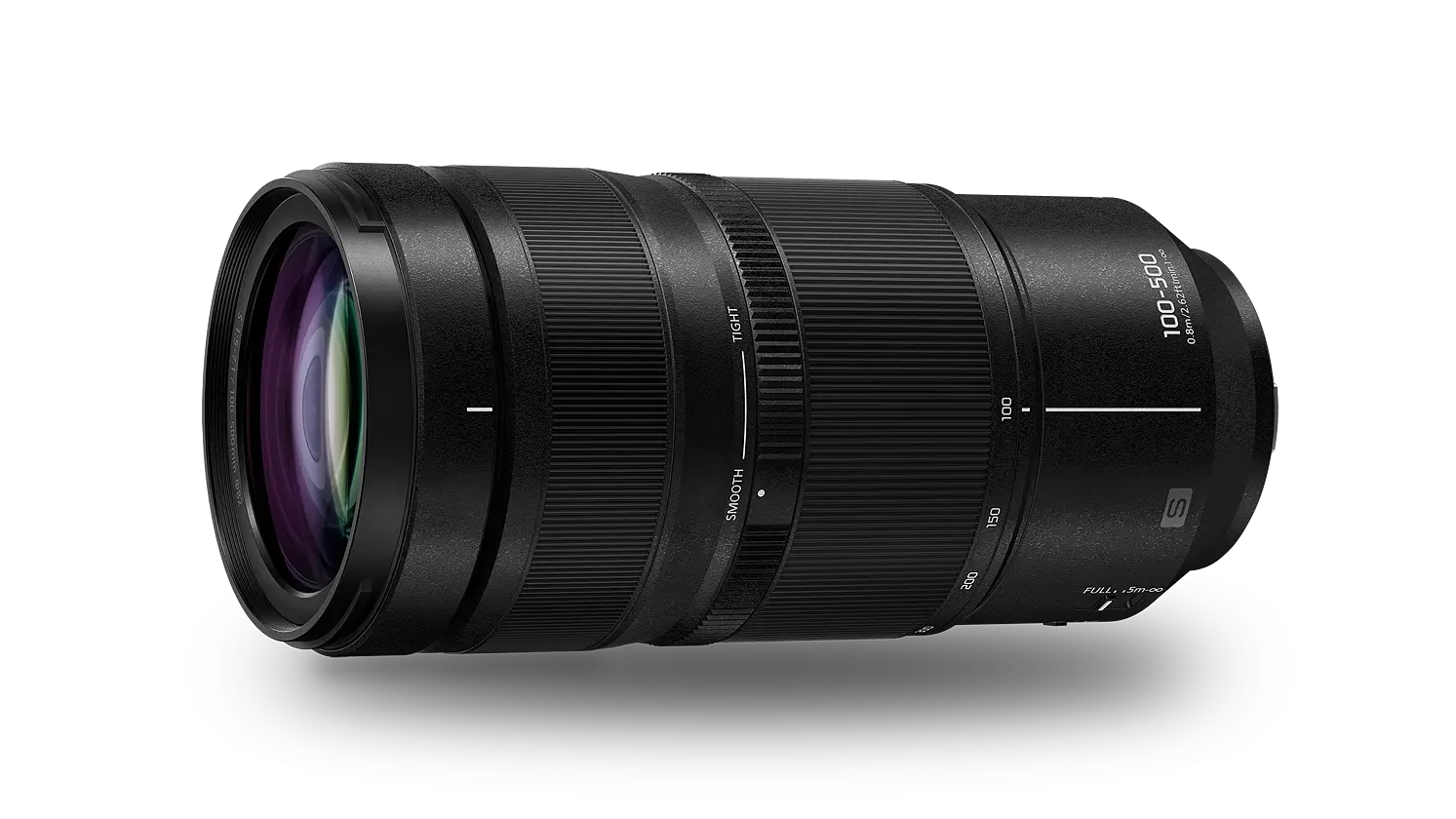
The Panasonic Lumix S 100-500mm is a premium, high-end zoom (not an out-and-out pro-level lens but one a pro might consider all the same). It’s aimed at sports, aviation and wildlife photographers; collectively, you could say ‘action’ photographers. It’s an interesting optical design comprising 19 elements in total, arranged in 12 groups, but the notable feature is the use of two Ultra ED (UED) glass elements, which Panasonic claims is close to Fluorite in performance. In addition, there are a further two ED and two Ultra High Refractive (UHR) glass elements; the latter are included to replace heavy, highly convex elements with thinner, less curved types, thus reducing both the size and weight of the lens while still delivering high image quality.

Compared with rivals, then, this lens is slightly lighter and more compact. Take the Canon RF 100-500mm F4.5-7.1 for example. That’s a 20-element lens with one Super UD element (similar to Fluorite performance) and no fewer than 6 UD elements. While it’s slightly ‘faster’ (around 0.3 EV) at the maximum aperture, the Canon is slightly heavier (+85 g lens only) and a little larger but much, much pricier. At £1,799 versus Canon’s £3,160 RRP, the Panasonic costs about 43% less. That’s a huge saving.

The Panasonic also has some nice additional features, including 11-aperture blades, a removable tripod collar that’s rock-solid and has an Arca-Swiss-style groove in the plate.  There are more high-end features as well. Naturally, it has OIS, but there’s a handy zoom collar to tighten it if wanted (useful at the longer end), a discrete custom button, and a focus limiter and a zoom limit switch to restrict the zoom range down to 150mm at the lower end.

Autofocus is driven by a Dual Phase Linear Motor, which moves the focusing elements directly rather than through a conventional geared drive. The result is fast, precise and quiet focusing, with the smooth operation also benefiting video. And Panasonic’s Dual Phase Linear Motor is particularly interesting because the S 100–500mm is also designed for video, with focus-breathing suppression and micro-step aperture control.

Check prices and order the Panasonic Lumix S 100-50mm F5-7.1 at the following retailers:

WEX Photo (UK) (£200 cash back)| Park Cameras (UK) |Panasonic Store (UK) (5yr warranty)

B&H Photo (US) | Adorama (US) | Panasonic Store (US)

Articles may include affiliate links. If you purchase through these links, we may earn an affiliate commission at no extra cost to you.

What’s It Like to Use?

While it’s smaller and lighter than rivals, it is still quite a big and heavy lens; it zooms to 500mm so there’s no getting around that.  However, it’s no more than, say, a well-built 70-20mm F2.8 from a few years ago.  Externally, this lens has Panasonic’s latest design cues, including decent rubber grips for the zoom and focusing collars. It also has their user-customisable elements; not just a customisable function button on the left-hand side, well-placed for thumb operation, but also a programmable focus ring.

The zoom ring is placed rearward of the focus ring, which is the layout I prefer, especially as most of the weight is close to the mount. This lets you zoom comfortably while supporting the lens, leaving the focusing to the camera. If the focus ring is reprogrammed as the control ring in AF, there’s a whole host of options available, including ISO and aperture, but others too. It’s nicely weighted and in manual mode it overrides the control dial options. 

With the Lumix S1 R II, one of the most customisable cameras you can buy, this camera allows the focusing ring to be repurposed in AF mode as a control ring. You can use it to adjust exposure compensation or aperture value, AF modes and a few others, including mimicking the settings allocated to the camera’s control dials. 

However, I set the function button to access and cycle through the AF modes and the focus ring to adjust exposure compensation when in AF mode (as the focusing ring is redundant then). Rivals do similar things but I found the Panasonic’s balance, handling and haptics to be first-class.

Having set the camera to these settings before means they’re transferred when changing lenses, including the ability to show the actual focal length in the viewfinder; at least that’s the case with the Lumix S1R II.  This allows you to select a focal length, and return to it it without takinig iit from your eye. It’s one of a handful of genuinely thoughtful features that are quite rare even on the most expensive cameras.

The lens is very nicely made, and the supplied hood is made to the same high-standard – so often manufacturers skimp on the hoods. Zooming is very smooth, and the ring is wide, but the focus ring looks a little narrow in comparison, though that didn’t actually cause an issue in use; Fine focusing in manual mode is easily accomplished as you can reprogram the focus throw linearly up to a long 1024 degrees.  

Controls for OIS and focusing limiting are quite small but again there were any issues in use. What’s curious is the position of the zoom restriction switch, which I didn’t notice for days, as it’s hidden away underneath the barrel close to the mount.

There’s no case or wrap included, but given the price, it’s easy to forgive, especially as there are some excellent options available if you want to go down that route (not everyone does obviously). 


MTF Charts

Panasonic’s MTF for the lens shows the performance wide open at 24mm and at 60mm. Between the two, the lens performs slightly better overall at 24mm but 60mm isn’t far behind. Centre performance is excellent at both ends, but there’s some curvature of field at 60mm in the corner, and it isn’t likely to be a problem.


How Does It Perform?

In terms of focusing speed, it’s fast, velvety-smooth, and practically silent, though, perhaps more importantly, it appears to be very reliable on the Lumix S1R II. Is it as fast, say, as the current leader? Perhaps not quite, but if you’re not regularly photographing sports, or even if you are, then I doubt you could tell the difference. In any case, a lens like this has to appeal to a broad base of users, including those who use video occasionally. 

Like nearly all modern lenses, this one adopts lens correction profiles for vignetting, distortion and fringing. You can switch them off for out-of-camera JPEGs/HEIFs and in software like Lightroom when processing RAW files, but you’ll probably want them enabled. Not that the lens really relies on them, as it’s well-corrected optically. Admittedly, there’s some vignetting at 24mm, but it soon disappears upon stopping down a stop or two. At the long end, 60mm, vignetting isn’t really noticeable wide open. Personally, I’m okay with some vignetting at and near the initial aperture, but it’s easily removed with or without the profile enabled.

Some barrel distortion is evident at 24mm and at wider focal lengths, leading to pincushion at the other end, as you might expect. Again, it’s hardly noticeable without correction, and you would have to compare side by side to see.

What’s more noticeable, perhaps, is that correcting distortion has a downside. This isn’t limited to this lens, of course, but correction crops into the image and can alter the composition, especially if elements are close to the edge. It also lowers the overall resolution, so it’s worth thinking about the effects. The heavier the distortion, of course, the more pixel wrangling is required. Reviewers tend to turn corrections off, sometimes even told to. But one way to mitigate this is to turn on in-camera corrections so you can see anything that might be too close to the edge and physically compensate by moving your position. Then, if your software enforces corrections, the composition shouldn’t be any different. Fortunately, most now are not doing so. 

Profile correction for chromatic aberration is also included, but it’s not really needed. At 24mm, where you might expect to see some Lateral CA, the lens reveals just how well corrected it is. There’s some mostly in the extreme corners, but the levels are relatively low, and it can be mitigated in Lightroom. Turning the profile off in Lightroom Classic shows you wouldn’t notice it anyway without zooming in to 300% or printing large-scale. Still, it’s important to add that when applying the correction profiles, most of that is cropped away anyway. 

At the other end, there’s the slightest hint of longitudinal CA (LoCA) wide open. This is harder to remove automatically. Profiles are mathematical anyway, and apply the same corrections for each lens of the same model regardless. Still, Lightroom Classic’s exceptional manual corrections do a good job of cleaning up most of it and will likely give better results than an auto-applied profile anyway.

Panasonic doesn’t make any claims about the effectiveness of their coatings, but they should. This lens is extremely resistant to ghosting and not too bad at handling flare either, which is usually the more troublesome. Admittedly, both can be provoked if you’re careless, but this lens is quite resistant to them, and besides, it ships with a decent, very nicely-made lens hood. A locking button avoids those awful friction-based hoods that make you feel like the barrel and AF motor will be damaged long before the hood locks in place. Bravo.

In terms of rendering, very few zooms score highly here, but this lens fares better than many I’ve tested, and it isn’t even that expensive in comparative terms. At the longer focal lengths, wide-open, transitions to out-of-focus elements in the background are smooth, and circular highlights are mostly free of distracting artefacts, such as “onion rings” (polishing marks on aspherical surfaces), and with only some very slight bright outer rings at times. Shorter focal lengths are naturally less likely to be as aesthetically pleasing, with some blurred backgrounds looking a little “busy”. Some slight double-edged effects can be seen at times. And on occasion, some coloured bokeh (spherochromatism) is visible on enlargement, though it’s slight. Given it’s a complex zoom, though, the drawing style of this lens is very impressive. Photographs are clean and accurate without being sterile-looking.

Panasonic Lumix S 100-500mm F5-7.1 Summary

I rarely use telephoto lenses – the longest I have owned is a 300mm, which was useful but so little used I sold it. However, I have reviewed dozens of telephoto primes and zooms over the years  

Breaking the mould can pay dividends, it seems, as this lens’s performance proves. If you can do without the extra 10mm to 70mm, you will get a smaller, lighter, more affordable high-speed standard zoom with no compromise on optical quality. While it may not quite reach the lofty optical performance of the very best (and priciest) 24-70mm lenses, it’s certainly no slouch in that department. In fact, it’s far superior to the best pro-level 24-70mm lenses of a decade ago and rivals many of the big names available today. Not only is the Lumix S 24-60mm F2.8 really well-made and customisable, but it handles well and focuses very quickly and quietly. With no obvious shortcomings, it’s easy for me to recommend. Indeed, it comes highly recommended.

What’s Hot

Great image quality
High-speed & quiet AF
Highly customisable
Excellent handling
Compact and lightweight
Great build
Decent hood
Price

What’s Not

Slight LaCA in extreme corners (mostly removed by profile correction)
No supplied case/wrap


Technical Data

UGREEN